
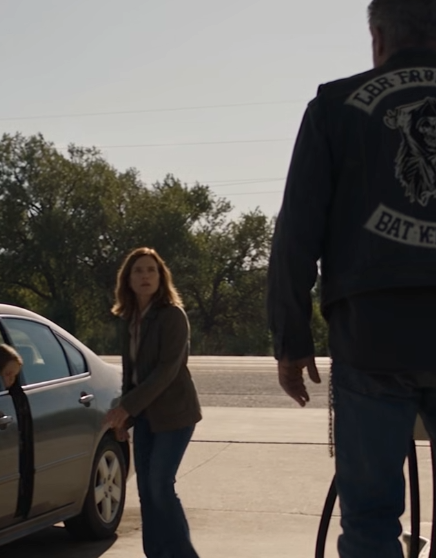
My Daughter Had Been Silent for Three Years Until She Saw a Biker and Said His Name. Then He Told Me What My Husband Had Asked Him to Hide Until She Spoke Again.
My daughter had not spoken for three years when she looked at a stranger beside a gas pump and said the one name I never knew she remembered.
“Ray.”
The biker dropped the gas nozzle.
It struck the concrete beside his boot with a hard metallic crack.
He didn’t look down.
He stared at my seven-year-old daughter as if the dead had just reached through time and touched his shoulder.
Ellie stood six feet away from him in white socks, her red jacket hanging open, her little hands curled at her sides.
“Ray,” she said again.
The man’s face went pale beneath his gray beard.
I ran toward her.
“Ellie!”
I caught her by the shoulders.
She barely noticed me.
Her eyes never left him.
For three years, I had prayed for one word.
Mom.
Water.
Hello.
Anything.
I had imagined what her voice might sound like after all that time.
I had imagined hearing it in a therapist’s office.
At breakfast.
In the middle of the night.
I had even imagined her waking from a nightmare and screaming, because at least a scream would mean the silence had broken.
But I had never imagined this.
My daughter’s first word in more than a thousand days was the name of a stranger.
The biker slowly raised his hands.
“How do you know that name?”
His voice shook.
I pulled Ellie closer.
“I’m sorry. I don’t understand what’s happening.”
He looked at me.
Then back at her.
“Nobody calls me Ray anymore.”
Ellie blinked.
The man swallowed.
“My name is Raymond, but I go by Reggie now.”
My heart began pounding.
“I haven’t used Ray in three years.”
Three years.
I felt something cold move through me.
He looked at Ellie again.
Then he asked the question that changed everything.
“Her father.”
I tightened my grip around her shoulders.
“What about him?”
“What happened to him?”
“He died.”
The biker’s jaw went rigid.
“When?”
I hesitated.
“Three years ago.”
His eyes closed.
“Route 9?”
I stopped breathing.
He opened his eyes.
“Near the quarry curve?”
For a second, the entire gas station seemed to disappear.
The cars.
The highway.
The hum of the pumps.
Everything.
“How do you know that?”
The man stared at Ellie.
“Was she wearing a red coat?”
I nearly stepped backward.
She had been.
I still had that coat folded in a box at the top of my closet.
“Who are you?”
He didn’t answer.
Instead, he reached into his wallet and removed an old folded piece of paper.
It was worn almost white along the creases.
He handed it toward Ellie.
“I’ve carried this for three years.”
She took it.
When she unfolded it, I saw crayon drawings.
A house.
Three stick figures.
A strange bird.
A dog.
And across the top, in a four-year-old’s careful block letters:
RAY.
I knew the paper.
It was a placemat from The Kettle, a diner near the Millbrook exit.
Danny had taken Ellie there on the last afternoon of his life.
The biker looked at me.
“I met your husband that day.”
My knees almost gave out.
And thirty minutes later, sitting at a weathered picnic table beside that gas station, I learned something no police officer, doctor, or investigator had ever told me.
My husband had not died alone.
This stranger had found the truck.
He had climbed into the ravine.
He had pulled Ellie from the wreck.
Then he had gone back for Danny.
He had stayed beside him until the ambulance came.
And Danny had spoken to him.
About me.
About Ellie.
About the life he knew he was leaving behind.
Ray told me Danny’s last message to me.
“Tell Sarah I loved her from the first minute.”
I broke apart when I heard it.
Nobody else knew that phrase.
Nobody.
Then Ellie spoke again.
“Daddy said you were good.”
Ray cried.
I cried.
And for a few beautiful minutes, I thought I finally understood why fate had brought us together.
I was wrong.
Because then Ray folded the old placemat and looked at me with an expression I couldn’t read.
“There’s something else.”
“What?”
“Your husband asked me to do one more thing.”
My hand tightened around Ellie’s.
Ray glanced at her.
Then at me.
“He made me promise I wouldn’t tell you until the right time.”
I stared at him.
“What right time?”
His answer made the hair rise along my arms.
“Until Ellie remembered me.”
I didn’t understand.
I told him so.
Ray sat with both hands around a paper cup of coffee the gas station attendant had brought him. He hadn’t taken a single sip.
“What do you mean, until Ellie remembered you?”
“That’s what Danny said.”
“No.”
I shook my head.
“That doesn’t make sense.”
“I know.”
“My husband was dying.”
“I know.”
“He couldn’t possibly know Ellie would stop speaking.”
Ray’s eyes dropped.
“I thought about that for three years.”
I waited.
“He didn’t say she would stop speaking.”
“Then what did he say?”
Ray looked at Ellie.
She had gone quiet again.
Not the frightening, locked silence I knew so well.
This was different.
She was listening.
Her small fingers traced the creases of the placemat.
Ray spoke carefully.
“He told me, ‘If she remembers your name someday, she’ll remember the rest.’”
My stomach tightened.
“The rest of what?”
“That’s the part I don’t know.”
I stared at him.
“You just said he asked you to do something.”
“He did.”
“What?”
Ray took a breath.
“He asked me to find something.”
“What?”
“He called it Ellie’s box.”
I frowned.
“Ellie doesn’t have a box.”
“That’s what he called it.”
“What kind of box?”
“He never got the chance to explain.”
Frustration cut through my grief.
“Then what exactly did he tell you?”
Ray closed his eyes for a moment, remembering.
“He said, ‘Tell Sarah to find Ellie’s box.’ Then he grabbed my arm and said, ‘But not until Ellie remembers Ray.’”
I felt a strange chill.
“Why?”
“He wouldn’t say.”
“Where is it?”
“I don’t know.”
“You’ve had three years.”
“I know.”
“You told me you were trying to find us.”
“I was.”
“Then why didn’t you find the box?”
His expression hardened—not with anger, but pain.
“Because, Sarah, until thirty minutes ago, I didn’t even know your last name.”
That stopped me.
He continued.
“The police wouldn’t give me your information. The hospital wouldn’t either. I left a letter. Nobody answered.”
I looked away.
He was right.
He had no address.
No phone number.
No way to find us.
Ray rubbed his thumb over the rim of the cup.
“For a while, I thought maybe Ellie’s box was something in the truck. The police told me everything recovered from the vehicle went to the family.”
“It did.”
“Was there a box?”
“No.”
“Something small? Metal? Wood?”
“No.”
“Maybe a toy chest?”
“No.”
“Something at your house?”
“I told you. There was nothing called Ellie’s box.”
He nodded slowly.
“That’s where I got stuck.”
Ellie suddenly tapped the placemat.
Once.
Then again.
We both looked at her.
She pointed to the crayon house.
“What, baby?” I asked.
Her lips parted.
Nothing came.
I didn’t push.
For three years, every specialist had warned me about turning speech into a test.
So I simply touched her hair.
“It’s okay.”
Ellie pointed again.
At the house.
Then she pointed at the dog.
I smiled sadly.
“You drew that at the diner.”
She nodded.
Ray leaned closer.
“Do you remember drawing the eagle?”
Ellie looked at him.
A long pause.
Then she nodded.
Ray’s eyes filled again.
“Do you remember me drawing it?”
Another nod.
I felt my heart beating faster.
“Ellie,” I said softly, “do you remember Daddy at the diner?”
Her fingers stopped moving.
Her face changed.
She pulled the placemat against her chest.
I immediately backed away from the question.
“That’s okay. You don’t have to answer.”
Ray nodded.
“No more questions.”
Ellie looked at him.
Then whispered:
“Dog.”
I looked down.
“Yes. You drew a dog.”
She shook her head.
“Daddy’s dog.”
I frowned.
“Daddy didn’t have a dog.”
Ellie stared at me.
“Before.”
“Before what?”
She struggled.
I could see it happening.
Her throat worked.
Her eyes squeezed shut.
“Before me.”
Ray and I exchanged a glance.
Danny had never owned a dog.
Not during our marriage.
Not as far as I knew before it.
At least, I didn’t think he had.
Then a memory surfaced.
A photograph.
Danny at maybe seventeen.
Standing beside an old pickup.
A dog beside him.
Black and white.
I had seen the picture only once.
His mother had shown it to me years earlier.
“What was that dog’s name?”
I whispered the question to myself.
Ellie answered.
“Scout.”
I stared at her.
“What?”
“Scout.”
My skin prickled.
I had never told Ellie that.
I wasn’t even sure I had remembered it correctly until she said it.
Ray leaned back.
“Scout.”
Ellie nodded.
Then she touched the crayon dog.
“Daddy said Scout knows.”
We left the gas station two hours later.
Ray followed us home on his motorcycle.
I normally would never have invited a man I had met beside a fuel pump into my house.
But Ray wasn’t a stranger anymore.
Not really.
He had held my daughter on the worst night of her life.
He had sat beside my husband while he died.
He carried Danny’s last words.
That made him something I didn’t have a name for.
Not family.
Not friend.
Something between witness and guardian.
Our house looked exactly as it always did when I pulled into the driveway.
White siding.
Green shutters.
Danny’s old maple tree beside the garage.
Yet I sat behind the steering wheel and felt as though I were arriving at a place I had never seen before.
Ellie unbuckled herself.
“Mom?”
I froze.
There it was again.
Mom.
I turned.
“Yeah, baby.”
“I’m hungry.”
I laughed and cried at the same time.
Ray, standing outside beside his motorcycle, politely looked away.
Those two ordinary words nearly destroyed me.
I’m hungry.
After three years of whiteboards and hand signals, my daughter had simply told me she wanted food.
I made grilled cheese sandwiches.
Ray sat at our kitchen table.
Ellie ate two.
She didn’t speak again.
And that was okay.
I had already received more than I had dared ask for.
Afterward, we went into the garage.
Danny’s things were still there.
Not all of them.
I had donated his clothes after the first year.
Sold his truck tools.
Given his fishing rods to his brother.
But there were boxes I had never opened.
Taxes.
Photographs.
Old work papers.
Christmas decorations.
We searched until sunset.
Nothing marked Ellie.
Nothing marked Scout.
Nothing that looked secret.
At eight thirty, Ray found an old photograph album.
He opened it.
There was Danny at sixteen.
Skinny.
Longer hair.
Standing beside an old Ford pickup.
And beside him sat a black-and-white border collie.
Scout.
Ellie touched the picture.
“That’s him.”
“How did you know about Scout?”
She shrugged.
“Daddy told me.”
“When?”
Her face tightened.
I immediately stopped.
Ray changed the subject.
“Look at your dad’s hair.”
Ellie giggled.
An actual sound.
Not quite a laugh.
But close.
We both stared at her.
She frowned at us.
“What?”
Ray burst out laughing.
I did too.
And then Ellie laughed because we were laughing.
For perhaps thirty seconds, my kitchen sounded like a home again.
The next morning, I called Danny’s older brother, Mark.
He lived in Tennessee.
We hadn’t spoken in almost a year.
Not because we fought.
Life simply does that sometimes.
People promise to stay close after a funeral.
Then weeks become months.
I asked about Scout.
“Lord,” Mark said. “That dog?”
“Yes.”
“What about him?”
“Did Danny ever have something called Scout’s box?”
Silence.
“Mark?”
“Where did you hear that?”
My heart jumped.
“So there was a box?”
Another pause.
“When we were kids, Dad built us lockboxes.”
“What kind?”
“Little cedar boxes. Maybe a foot wide. One for me, one for Danny.”
“What did Danny keep in his?”
“Kid stuff. Baseball cards. Pocketknife. Letters. Why?”
“Where is it?”
“No idea.”
“Think.”
“Sarah, that was forty years ago.”
“Please.”
He heard something in my voice.
“All right.”
I waited.
“When Mom sold the old house, she gave us whatever was left in the attic. Danny took a couple boxes home.”
“When?”
“Maybe six years before he died.”
I closed my eyes.
Six years.
Ellie would have been a baby.
“Was Scout connected to it?”
Mark laughed softly.
“Scout used to sleep under Danny’s bed. Danny hid that cedar box beneath the loose floorboard there. We called it the Scout box because the dog would growl whenever I tried to get near it.”
My heart began pounding.
“Mark, where was your childhood house?”
“You know where it was.”
“No. I don’t.”
“Yes, you do.”
“Mark.”
“The old farmhouse outside Bellweather.”
I stopped.
Danny had taken Ellie to Bellweather on the day he died.
The Kettle was on the road back.
“What?”
Mark continued.
“Dad sold it when Mom died. Why?”
“Who owns it now?”
“No clue.”
I looked toward the living room.
Ellie was sitting on the rug drawing.
A house.
A dog.
Three people.
The same picture from the placemat.
Except this time there was something new.
A square beneath one of the windows.
By noon, Ray was back.
We drove to Bellweather.
The old farmhouse still stood.
Barely.
The paint had faded.
One porch railing leaned outward.
The barn behind it was half collapsed.
But when Ellie saw the house, she sat upright.
“Here.”
I looked at her.
“You’ve been here?”
She nodded.
“With Daddy?”
Another nod.
Ray glanced at me from the passenger seat.
I pulled over.
The property belonged to a retired teacher named Mrs. Helen Mercer.
She was eighty-two.
When I explained who I was, she stared at me for a moment.
Then her face softened.
“Danny Carter’s wife.”
“Yes.”
“Oh, honey.”
She opened the door wider.
“I remember him.”
“You do?”
“He came here with his little girl.”
My knees weakened.
“When?”
Mrs. Mercer looked at Ellie.
“Three years ago.”
The day of the accident.
I knew it before she said it.
“He called first,” she continued. “Said he grew up here and wanted to show his daughter the house.”
“Did he go inside?”
“Of course.”
“Where?”
“Everywhere.”
“Did he go into his old bedroom?”
She smiled.
“He spent twenty minutes in there.”
Ray and I looked at each other.
Mrs. Mercer saw it.
“What is this about?”
“I don’t know yet.”
She let us in.
The house smelled like cinnamon and old wood.
Ellie walked ahead.
Not uncertainly.
Not exploring.
Remembering.
She climbed the stairs.
Turned left.
Entered the second bedroom.
Then stopped beside the wall.
Mrs. Mercer watched in amazement.
“That was his room.”
Ellie crouched.
She touched a floorboard beneath the window.
“Here.”
Ray knelt.
The board had been replaced recently enough that the nails were cleaner than the surrounding wood.
Mrs. Mercer brought a small pry bar.
Ray carefully lifted it.
Beneath was dust.
Insulation.
And an empty rectangular space.
Nothing else.
My heart sank.
“No.”
Ray reached inside.
Empty.
Mrs. Mercer frowned.
“I’m sorry.”
Ellie stared at the hole.
Then shook her head.
“No.”
She stood.
“Daddy took it.”
I turned.
“What?”
“He took the box.”
My pulse jumped.
“You saw him?”
She nodded.
“Where did he put it?”
“In the truck.”
Ray slowly stood.
“The police inventory.”
I had read it dozens of times.
Wallet.
Phone.
Wedding ring.
Broken sunglasses.
Child’s backpack.
Red coat.
One stuffed rabbit.
Loose change.
Documents.
No cedar box.
Then I remembered something else.
The truck had been found on its side.
The rear window shattered.
Personal belongings had been scattered down the slope.
Search crews recovered what they could.
Not everything.
Ray understood at the same moment I did.
“The ravine.”
Three days later, we returned to Route 9.
I had avoided that road for three years.
Now I stood beside the guardrail with Ellie holding my hand.
The state had replaced the damaged section.
New steel.
New bolts.
But the trees below looked the same.
Ray stood several feet away.
He had gone quiet.
“This is where you found them?”
He nodded.
Ellie squeezed my hand.
“You don’t have to go down,” I told her.
She looked at Ray.
“I want to.”
We went slowly.
The slope was steep.
Ray showed us where the truck had stopped.
The tree still carried an old scar in its bark.
I couldn’t look at it for long.
We searched for two hours.
Nothing.
Then Ellie wandered toward a cluster of rocks.
She stopped.
“Mom.”
I hurried over.
There was a narrow drainage ditch running beneath fallen leaves.
Something brown was wedged beneath a flat stone.
Ray saw it first.
He dropped to his knees.
Pulled away leaves.
Mud.
Branches.
Then he stopped.
A corner of cedar wood appeared beneath the dirt.
My breath caught.
Ray worked it free.
The box was battered.
Water-stained.
One hinge broken.
But intact.
On the lid, barely visible beneath the mud, were two carved letters.
D.C.
Danny Carter.
Ellie touched them.
“Daddy.”
Ray handed the box to me.
It was locked.
At home, I sat at the kitchen table staring at it for almost an hour.
I was afraid to open it.
That sounds ridiculous.
I had spent three days searching for the thing.
Now that I had it, I wanted to put it back beneath the earth.
Ray understood.
“Tomorrow,” he said.
“No.”
“You don’t have to do this tonight.”
“If I wait, I’ll never do it.”
The lock had rusted.
A screwdriver broke it.
Inside were childhood treasures.
Baseball cards.
A pocketknife.
A Scout patch from a summer camp.
A photograph of Danny’s parents.
A dog collar.
Letters.
And beneath everything, sealed inside a plastic freezer bag, was a white envelope.
My name was written across the front.
SARAH.
I stopped breathing.
Ray stood.
“I should leave.”
“No.”
“This is for you.”
“Stay.”
He hesitated.
“Please.”
He sat.
I opened the envelope.
Inside was a letter.
The date at the top was the day Danny died.
My hands shook so badly I could barely hold it.
Sarah,
If you’re reading this, then something went wrong before I could tell you myself.
I stopped.
“No.”
Ray leaned forward.
“What?”
I kept reading.
There is something I should have told you years ago.
I didn’t because I was afraid.
Not of you.
Of losing the life we built.
I looked at Ray.
“What did he do?”
Ray shook his head.
“I don’t know.”
The next lines were worse.
Before Ellie was born, I made a promise to someone.
I broke it.
Today I tried to fix that.
I felt sick.
A promise to someone?
Who?
I continued.
You once asked why I never talked about the year after high school.
I told you there was nothing worth telling.
That was a lie.
My heart hammered.
Ray stood again.
“Sarah—”
“Sit down.”
He did.
I turned the page.
When I was eighteen, I thought I was going to be a father.
The room tilted.
I read the sentence again.
Then again.
Ray said nothing.
The girl’s name was Rebecca.
She was seventeen.
We were stupid and scared.
Our parents decided everything for us.
The baby was adopted.
I signed papers.
I told myself it was the right thing.
I never saw the child.
I never told you.
I covered my mouth.
Danny had a child.
Before me.
Before our marriage.
Before everything.
My husband of thirty-one years had carried this secret his entire adult life.
I wanted to throw the letter.
I wanted to tear it apart.
I wanted him alive so I could scream at him.
But I kept reading.
Two months ago, I received a letter.
The child found me.
His name is Matthew.
He is thirty-five years old.
He does not want money.
He does not want to disrupt our family.
He only wanted to know where he came from.
Today I went to meet him.
The words blurred.
Bellweather.
That was why Danny had gone there.
Not just the farmhouse.
He had taken Ellie to meet—
Her brother.
My hands went numb.
“Sarah?”
I couldn’t answer.
I read the final paragraphs.
I took Ellie because I was tired of secrets.
She met him.
She knows him only as Matt.
I was going to tell you tonight.
I swear to you.
I know you may hate me for waiting this long.
But there is one thing I need you to understand.
Matthew has a daughter.
Her name is Grace.
She is six.
Ellie met her today.
They played together in the yard.
Ellie asked why Grace looked like her.
I told her they were family.
My breath stopped.
Ellie had met a brother I didn’t know existed.
A niece.
Hours before Danny died.
The letter ended:
If I don’t get home, find Matthew.
Not for me.
For Ellie.
She should not lose more family because I was a coward.
His number is beneath Scout’s collar.
I love you.
I am sorry.
Danny.
I sat there.
Silent.
Ray did not speak.
Ellie was asleep upstairs.
The clock ticked.
My refrigerator hummed.
Everything ordinary continued while my marriage rearranged itself inside my head.
Finally Ray whispered:
“Do you want me to find the number?”
I shook my head.
“No.”
Then:
“Yes.”
Under Scout’s old collar was a folded card.
A phone number.
And an address.
Forty minutes away.
I did not call.
Not that night.
Not the next morning.
I was angry.
Angrier than I had ever been with Danny while he was alive.
He had lied to me.
For thirty-one years.
Every anniversary.
Every Christmas.
Every conversation about our past.
There had been another child.
Maybe he had been eighteen.
Maybe adults had pressured him.
Maybe he had been ashamed.
But he had married me with that secret.
Built a life with me.
Had Ellie with me.
And never told me.
Then he had taken our daughter to meet his son before telling his wife.
That hurt almost more than the secret itself.
For the first time since Danny died, I allowed myself to be furious with him.
Grief makes saints of the dead.
We polish them.
We erase the arguments.
We forgive habits that once drove us crazy.
We turn complicated people into photographs.
But Danny had been a man.
And men can love deeply while still being afraid.
Men can be good and still fail people.
I realized I had spent three years mourning a perfect version of my husband who had never actually existed.
That realization hurt.
But strangely, it also brought him closer.
The real Danny had been scared.
Flawed.
Ashamed.
Trying, on his final day, to correct something he should have corrected decades earlier.
I hated what he had hidden.
I loved him anyway.
Both things were true.
On Friday morning, Ellie came downstairs carrying the whiteboard she hadn’t used since the gas station.
She put it on the kitchen table.
Then she looked at me.
“Are we going?”
“Where?”
“To see him.”
My stomach tightened.
“Who?”
She looked confused.
“Matt.”
“You remember him?”
She nodded.
“Why didn’t you tell me?”
Her face fell.
I regretted the question instantly.
“No, sweetheart. I’m not angry. I’m just trying to understand.”
Ellie sat.
“Daddy said surprise.”
“What surprise?”
“He said we tell Mommy tonight.”
Of course.
Danny had turned it into something simple for a four-year-old.
A surprise.
Then the accident happened.
Trauma swallowed everything.
“Do you remember Grace?”
A tiny smile appeared.
“She has my nose.”
I laughed despite myself.
Apparently that was what Ellie had meant when the letter said she asked why they looked alike.
“Do you want to see them?”
“Yes.”
I looked at the phone number on the table.
Then I called.
A man answered on the fourth ring.
“Hello?”
I couldn’t speak.
His voice sounded nothing like Danny.
Then again, I had expected it to.
“Hello?”
“My name is Sarah Carter.”
Silence.
A long one.
Then a breath.
“Oh.”
Just that.
Oh.
I closed my eyes.
“You knew my husband.”
“Yes.”
“You met him three years ago.”
“Yes.”
“On October seventeenth.”
“Yes.”
His voice had changed.
“Mrs. Carter—”
“Sarah.”
Another silence.
“Sarah.”
I heard him swallow.
“I’m sorry.”
“For what?”
“For everything.”
“Did you know he died that day?”
“Yes.”
“How?”
“I saw it on the news two days later.”
“And you never contacted me?”
“I tried.”
My anger flared.
“How?”
“I went to the funeral.”
I froze.
“What?”
“I stayed across the street.”
The memory hit me.
Hundreds of faces.
Neighbors.
Hospital coworkers.
Church members.
Danny’s old friends.
A man standing alone beneath an oak tree across from the cemetery.
I barely remembered him.
“I couldn’t walk in,” Matthew said.
“Why?”
“Because what was I supposed to say?”
His voice broke.
“Hello, I’m the son your husband never told you about?”
I had no answer.
“He told me he was going home to tell you,” Matthew continued. “Then he died.”
“So you disappeared.”
“I thought that was what he would have wanted if he couldn’t explain it himself.”
“No.”
“I know that now.”
“You don’t know anything about what he wanted.”
“No.”
His voice became quiet.
“You’re right.”
That disarmed me more effectively than an argument would have.
Then I heard a child in the background.
“Dad?”
My chest tightened.
Matthew covered the phone.
“One second, Gracie.”
Ellie heard the name.
She ran into the kitchen.
“Grace?”
Matthew went silent.
I put the phone on speaker.
“Matthew.”
“Yes?”
“Someone wants to talk to you.”
Ellie leaned toward the phone.
“Hi, Matt.”
A sound came through the speaker.
Half laugh.
Half sob.
“Ellie?”
She smiled.
“Yeah.”
“Oh my God.”
Then another voice.
A little girl.
“Ellie?”
Ellie’s entire face lit up.
“Grace!”
The two girls began talking as though three years had been three days.
I sat at the kitchen table listening.
Ray stood in the doorway.
He had arrived ten minutes earlier and heard enough to understand.
He quietly removed his sunglasses.
Wiped his eyes.
And for the first time since opening Danny’s letter, my anger loosened its grip.
We met Matthew the following afternoon.
I recognized him immediately.
Not because he looked exactly like Danny.
He didn’t.
He was taller.
Lean.
Dark hair instead of Danny’s sandy brown.
But he had Danny’s hands.
The same long fingers.
The same habit of rubbing his thumb across his knuckle when nervous.
When he saw me, he stopped.
For a moment, neither of us knew what to do.
Then he said:
“I don’t expect you to forgive me.”
“For what?”
“For existing, mostly.”
That hurt.
“You don’t need forgiveness for that.”
His eyes filled.
Behind him stood Grace.
Ellie ran to her.
They hugged.
No hesitation.
Children are sometimes better at family than adults.
Matthew watched them.
“Dad talked about you.”
The word Dad struck strangely.
“He did?”
“All afternoon.”
“What did he say?”
Matthew smiled.
“That you were smarter than him.”
“That sounds like Danny.”
“That you could tell when he was lying.”
I almost laughed.
“Apparently not always.”
Matthew’s smile vanished.
“I told him he needed to tell you.”
“He planned to.”
“I know.”
We sat on his porch.
Ray stayed near his motorcycle, giving us space.
Matthew told me everything.
His adoptive parents had been good people.
He had known he was adopted since childhood.
He didn’t search for Danny until after his adoptive mother died.
He wasn’t looking for a replacement father.
He wanted medical history.
A photograph.
Maybe a conversation.
Danny had responded to his first letter within three days.
They exchanged messages for two months.
Then Danny suggested meeting.
At the old farmhouse.
“The first thing he did was apologize,” Matthew said.
“For giving you up?”
“For hiding me.”
I looked at him.
“He said the adoption wasn’t something he regretted because my parents gave me a good life. But he regretted turning me into a secret.”
Matthew looked toward Grace and Ellie.
“He said secrets make people feel like mistakes.”
That sounded exactly like Danny.
“What happened that afternoon?”
“We talked.”
“For how long?”
“Hours.”
“And Ellie?”
“She and Grace played.”
“Did he tell you about the box?”
Matthew frowned.
“What box?”
“The cedar box.”
“No.”
“He went into the old bedroom.”
“Yeah.”
“Why?”
“He said there was something he needed.”
“The letter.”
Matthew nodded slowly.
“That must have been it.”
I looked toward Ray.
Something still bothered me.
Danny had written the letter before the crash.
He had hidden it in a childhood box.
Then retrieved it.
Why not simply bring it home?
Why tell Ray to find it?
Because after the crash, the box had disappeared.
But Danny couldn’t have known it would disappear.
Unless—
I looked at Ray.
“What exactly did Danny say?”
Ray frowned.
“I told you.”
“No. Every word.”
He came closer.
“Sarah—”
“Please.”
Ray thought.
“He said, ‘Find Ellie’s box.’”
“Then?”
“He said, ‘If she remembers Ray, she’ll remember the rest.’”
“Exactly?”
“Yes.”
“Nothing else?”
Ray stared toward the girls.
Then his face changed.
“There was one thing.”
My heart accelerated.
“What?”
“I thought he was confused.”
“What did he say?”
Ray hesitated.
“He said, ‘Don’t trust the first story.’”
Matthew stood.
“What?”
Ray looked embarrassed.
“He was badly hurt. I thought he was talking nonsense.”
My skin went cold.
“What first story?”
“I don’t know.”
Matthew looked at me.
Then at Ray.
“What did the police say caused the crash?”
“Wet pavement.”
Ray shook his head.
“It hadn’t rained.”
Nobody moved.
“What?”
Ray looked toward me.
“It rained later that night. But when I found them, the road was dry.”
I remembered the report.
Loss of control on wet pavement.
I had never questioned it.
Why would I?
My husband was dead.
My daughter traumatized.
I had accepted whatever explanation authorities gave me because I needed an explanation.
Matthew’s voice lowered.
“Was there another vehicle?”
Ray stared at him.
“I saw tire marks.”
My heart pounded.
“What kind?”
“Two sets.”
Silence.
Ray continued.
“One from Danny’s truck.”
“And the other?”
“Stopped near the guardrail.”
Matthew looked at me.
“Did the police photograph them?”
“I don’t know.”
Ray’s jaw tightened.
“They should have.”
A terrible thought entered my mind.
“Ray.”
“Yes?”
“When you reached Danny…”
I struggled to form the question.
“Did he say another car caused it?”
“No.”
“Did he mention another driver?”
“No.”
“Then what does ‘don’t trust the first story’ mean?”
Ray shook his head.
“I don’t know.”
Ellie had stopped playing.
She was watching us.
Then she spoke.
“There was a blue car.”
Every adult turned toward her.
I crouched in front of Ellie.
“What blue car?”
Her face changed.
She looked frightened.
Ray immediately moved backward.
“Easy.”
I nodded.
“Sweetheart, you don’t have to tell us anything.”
Ellie looked at Grace.
Grace took her hand.
Then Ellie whispered:
“The man was mad.”
My stomach dropped.
“What man?”
“I don’t know.”
“Did he talk to Daddy?”
She nodded.
“Where?”
“At the old house.”
Matthew frowned.
“Nobody else came.”
Ellie shook her head.
“Road.”
Matthew looked at me.
“After they left here.”
Ellie nodded.
“A blue car followed you?”
Another nod.
Ray crouched several feet away.
“Did your daddy know the man?”
Ellie looked at him.
“I think.”
“What happened?”
Her breathing quickened.
I stopped him.
“That’s enough.”
But Ellie shook her head.
“I remember.”
She squeezed Grace’s hand.
“The blue car came close.”
My chest tightened.
“Then?”
“Daddy said a bad word.”
Despite everything, Matthew almost smiled.
“That definitely sounds like him.”
Ellie gave a tiny smile.
Then it vanished.
“He told me to hold tight.”
“What happened after that?”
Her eyes filled.
“Bang.”
I grabbed her.
“No more.”
She buried her face in my shoulder.
That night I called the state police.
The original investigator had retired.
A younger detective agreed to review the file.
I expected nothing.
Three days later, he called.
“There’s something odd.”
“What?”
“The weather report.”
My hand tightened around the phone.
“The crash report says wet roadway.”
“Yes.”
“But the nearest weather station recorded no rain until 8:17 p.m.”
“What time was the crash?”
“Approximately 6:40.”
I closed my eyes.
“What else?”
“Photographs show a second set of tire marks.”
My heart stopped.
“Was another vehicle investigated?”
“Not that I can find.”
“Why?”
“I don’t know.”
He paused.
“There’s also a witness note.”
“What witness?”
“Someone reported seeing a dark blue sedan traveling behind your husband’s truck several miles before the curve.”
“Did they get a plate?”
“Partial.”
“Whose car?”
“We’re working on it.”
For the next week, I barely slept.
Then the detective called again.
The blue sedan had been registered to someone I knew.
Not well.
But enough.
Danny’s older brother, Mark.
I called Mark.
He denied everything.
“I wasn’t there.”
“Your car was.”
“No.”
“Someone saw it.”
“They’re wrong.”
“Ellie remembers a blue car.”
Silence.
Then:
“She was four.”
My blood turned cold.
I had not told him Ellie’s age in that conversation.
Of course he knew her age.
He was her uncle.
But something about the speed of the answer bothered me.
“Why did you tell me the house was sold?”
“What?”
“The farmhouse.”
“It was.”
“Why didn’t you tell me Danny went there that day?”
“I didn’t know.”
“Did you know about Matthew?”
Silence.
“Mark?”
His voice changed.
“Sarah, leave this alone.”
Every hair on my arms rose.
“Why?”
“Because Danny is dead.”
“That’s exactly why I won’t.”
He hung up.
The police found him the next morning.
He hadn’t fled.
He was sitting in his kitchen.
Waiting.
The truth was uglier and smaller than I expected.
There had been no murder plot.
No planned attack.
No secret criminal empire.
Just fear.
Money.
And two brothers who had carried an old family secret differently.
Mark knew about Matthew.
Their mother had told him years earlier.
When Matthew contacted Danny, Mark panicked.
Their father had left a small piece of land in a trust with language dividing it among “all biological descendants.”
The land had become valuable after a development company offered to purchase it.
Mark believed Matthew’s appearance could complicate the sale.
He begged Danny not to acknowledge him.
Danny refused.
They argued.
Mark followed him from Bellweather.
He tried to force Danny to pull over.
At the quarry curve, Mark moved alongside the truck.
Too close.
Danny swerved.
The tire hit gravel.
The truck went through the guardrail.
Mark stopped.
He walked to the edge.
He saw the truck below.
And then he did the thing that would haunt me more than anything else.
He left.
He told himself he was going to find help.
He didn’t.
He drove home.
Later, when police contacted family, he said nothing.
When the report mistakenly blamed wet pavement, he let them believe it.
For three years.
I thought that was the final truth.
It wasn’t.
Because Mark had one more thing to tell investigators.
Something even Ray didn’t know.
When Mark looked over the guardrail, before he drove away, Danny was standing outside the truck.
Alive.
Walking.
That made no sense.
Ray had found Danny trapped behind the steering column.
The detective showed me Mark’s statement.
I read it three times.
Then I called Ray.
He came immediately.
“That’s impossible,” he said.
“I know.”
“When I reached him, he was trapped.”
“Could he have gotten out and gone back in?”
“Why?”
Neither of us had an answer.
Until Ellie did.
“He came back for the box.”
We stared at her.
“What?”
“The box fell out.”
My heart stopped.
Ellie’s memories were returning in pieces now.
Not like a movie.
Images.
Sounds.
Fragments.
She remembered the truck hitting the tree.
She remembered hanging upside down.
She remembered Danny unbuckling himself.
He had been hurt but mobile.
He crawled out.
Then he saw the cedar box lying farther down the slope.
He went after it.
Why?
Because it contained the letter.
Because it contained Matthew’s number.
Because Danny had spent thirty-five years hiding one son and had decided, on the last day of his life, that he would never allow the truth to disappear again.
He retrieved the box.
Then he heard Ellie crying.
He climbed back to the truck.
While trying to reach her, the unstable vehicle shifted against the tree.
The steering column crushed him.
Danny had escaped the wreck.
Then he went back.
Not for the box.
Not for himself.
For Ellie.
That was how he became trapped.
Ray sat silently when Ellie finished.
Then he whispered:
“That’s why.”
“What?”
Ray looked at me.
“That’s why he wasn’t asking me to save him.”
He closed his eyes.
“He already knew what it cost to go back.”
Mark pleaded guilty to leaving the scene and other charges connected to the crash.
I never visited him.
I never wrote.
Matthew did once.
He wouldn’t tell me what he wrote.
I didn’t ask.
The land was eventually sold.
Matthew refused his share.
So did I.
We placed the money into two education funds.
One for Grace.
One for Ellie.
Ray became part of our family in the strange way some people do without anyone officially deciding it.
At first, he visited once a week.
Then Sundays.
Then holidays.
Ellie called him Ray.
Everyone did.
He stopped using Reggie.
“I think I’m ready to have my name back,” he told me.
Ellie continued therapy.
Her speech did not magically return all at once.
Some days she talked for hours.
Some days she used her whiteboard.
Sometimes certain memories shut the words down again.
Her therapist told me recovery was not a straight road.
We stopped measuring progress in sentences.
We measured it in trust.
Grace helped.
Matthew helped.
Ray helped.
And somehow, so did the truth.
Six months after the gas station, we returned to The Kettle.
It had barely changed.
Same counter.
Same cracked red booths.
Same smell of coffee and pancakes.
Ray sat beside Ellie.
She ordered bear-shaped pancakes.
When they arrived, she laughed.
“You want me to draw another eagle?” Ray asked.
“No.”
“Why not?”
“You’re bad at it.”
I laughed so hard coffee came out my nose.
Ray looked offended.
“I saved your life and this is the respect I get?”
Ellie grinned.
“You draw chickens.”
“Eagles.”
“Chickens.”
Matthew and Grace were with us.
For the first time, I looked around the table and understood something Danny had tried too late to understand himself.
Family is not made safer by hiding the truth.
Secrets do not protect love.
They make love fragile.
Truth can hurt.
It can anger.
It can change the way you remember someone.
But if love is real, truth gives it something secrets never can.
A chance to survive the whole person.
Not the polished version.
The whole one.
After breakfast, Ellie asked for a paper placemat.
She began drawing.
A house.
A mother.
A little girl.
A man with a beard.
Another man.
Another little girl.
A dog.
Ray pointed at it.
“Who’s the dog?”
“Scout.”
“Of course.”
Then Ellie added one more person.
A man standing slightly away from the others.
Danny.
My throat tightened.
She drew him smiling.
When she finished, she wrote names above everyone.
MOM.
ELLIE.
RAY.
MATT.
GRACE.
DADDY.
Then she looked at me.
“Mom?”
“Yes?”
“Can dead people know things?”
I swallowed.
“What kind of things?”
“Like if we’re okay.”
I looked toward the window.
Sunlight lay across the parking lot.
Three years earlier, Danny and Ellie had left this diner and driven toward the worst moment of our lives.
For a long time, I had wished I could change that day.
Make him take another road.
Make me call him five minutes earlier.
Make Mark stay home.
Make the truck stop.
Make Ray arrive sooner.
Anything.
Now I understood there was no version of grief where changing one minute did not change a thousand others.
“I don’t know,” I told her.
She considered that.
Then nodded.
“I think Daddy knows.”
“Why?”
“Because Ray found us.”
Ray looked down.
His eyes filled.
Ellie continued drawing.
I thought the story ended there.
It should have.
But nine months after the gas station, I received a package.
No return address.
Inside was a small digital recorder.
And a note from the retired state trooper who had handled Danny’s accident.
Mrs. Carter,
This was found among archived evidence during the reopened investigation. It was incorrectly labeled and never returned to your family. I believe it belonged to your husband.
My hands shook.
The recorder was old.
Danny used it for work.
He was a building inspector and hated typing notes while driving, so he recorded reminders.
I charged it.
There were seventeen audio files.
Most were ordinary.
Roof measurements.
Addresses.
Supply lists.
Then I found the final recording.
Time stamp:
6:31 p.m.
Nine minutes before the crash.
I pressed play.
Road noise.
Danny’s voice.
“Okay. Note to self. Tell Sarah everything tonight.”
My chest tightened.
Then another voice.
Ellie.
Four years old.
Clear.
Bright.
Before silence had taken her.
“Daddy?”
“Yes, bug?”
“Is Matt my brother?”
Danny laughed.
“Yeah, sweetheart.”
“And Grace is my family?”
“She sure is.”
“Is Mommy gonna be mad?”
A pause.
“Probably.”
I laughed through my tears.
Ellie, now sitting beside me on the couch, smiled.
On the recording, Danny continued.
“But your mom has the biggest heart of anybody I know.”
“Bigger than yours?”
“Way bigger.”
“Bigger than Ray’s?”
Silence.
I froze.
Ray was sitting across the room.
His head snapped up.
The recording had been made after the diner.
Danny answered:
“You liked Ray, huh?”
“He draws bad birds.”
Ray covered his face.
Even now.
Even here.
We laughed.
Then the recording changed.
Danny’s voice became serious.
“Ellie, listen to Daddy.”
“What?”
“If we ever get scared, what do we do?”
“Find a good person.”
“That’s right.”
“How do we know?”
“We look what they do.”
“That’s my girl.”
Then road noise.
A turn signal.
Danny muttered something.
“What is it, Daddy?”
“Nothing.”
A few seconds passed.
Then:
“That car’s back.”
My blood went cold.
The blue sedan.
Danny sighed.
“Your uncle needs to grow up.”
Ellie’s voice:
“Is he mad?”
“Yeah.”
“Are you mad?”
“No.”
A pause.
Then Danny said something I will remember until I die.
“Being mad doesn’t mean you stop loving somebody. It just means something needs to change.”
The recording continued.
Mark’s car came closer.
Danny cursed.
Then the audio ended.
I sat in silence.
Ray stared at the recorder.
Matthew wiped his eyes.
Ellie leaned against me.
And suddenly Ray said:
“Play the beginning again.”
“What?”
“The part about finding a good person.”
I replayed it.
If we ever get scared, what do we do?
Find a good person.
How do we know?
We look what they do.
Ray stood.
He walked toward the window.
His shoulders began shaking.
“What is it?” I asked.
He turned.
“You don’t understand.”
“What?”
“That wasn’t something Danny made up in the truck.”
I frowned.
Ray reached into his wallet.
He still carried the placemat.
He unfolded it.
Then turned it over.
None of us had paid much attention to the back.
There were restaurant advertisements.
A maze for children.
A word search.
And in the bottom corner, written faintly in blue ink, were four words.
LOOK WHAT PEOPLE DO.
I stared at them.
“Who wrote that?”
Ray was crying.
“I did.”
“When?”
“At the diner.”
He sat down.
“Ellie asked why I had an eagle on my vest.”
He touched the patch.
“I told her it was supposed to remind us to watch over people.”
He laughed sadly.
“She asked how you know if somebody is good.”
I looked at the recorder.
Then at him.
“What did you tell her?”
Ray wiped his face.
“I said, ‘Don’t listen to what people say about themselves. Look at what they do.’”
Nobody spoke.
Danny had heard him.
Danny had remembered.
Hours later, trapped in a ravine and knowing he was dying, he told his daughter to remember Ray.
Not because Ray was magical.
Not because Danny knew the future.
Not because he somehow predicted she would lose her voice.
Because on the last day of his life, Danny had finally understood the lesson he had spent thirty-five years avoiding.
People are not their secrets.
They are not their mistakes.
They are not the stories they tell about themselves.
In the end, when everything else is stripped away—
look at what they do.
Mark said he loved his brother.
Then drove away.
Ray called himself a failure.
Then climbed down a ravine for strangers.
Danny called himself a coward.
Then went back into a wrecked truck for his daughter.
Matthew feared he was an unwanted secret.
Then welcomed us without asking for anything.
And Ellie—
My silent little girl—
had spent three years carrying the final instruction her father gave her.
When she saw the gray-bearded biker at that gas station, she did exactly what Danny had asked.
She remembered.
Not everything.
Just enough.
One name.
One safe person.
One word.
Ray.
I thought that was the miracle.
But the final surprise came a year after the accident investigation closed.
It happened on Ellie’s ninth birthday.
We were in the backyard.
Matthew was grilling burgers.
Grace was chasing bubbles.
Ray was pretending not to be terrified while Ellie climbed onto his motorcycle for a photograph.
I had finally taken Danny’s cedar box out of my bedroom closet.
We used it now to keep family photographs.
Not secrets.
Photographs.
I was adding pictures from the birthday when I noticed something strange about the old placemat.
One corner felt thicker than the others.
I carefully separated two layers of paper that had stuck together after years of water damage.
Something fell onto the table.
A tiny photograph.
Polaroid-sized.
I picked it up.
My heart stopped.
It showed a much younger Ray.
No gray beard.
Dark hair.
Maybe thirty.
Standing beside a motorcycle.
And next to him—
Danny.
Young.
Maybe twenty.
Both laughing.
Arms over each other’s shoulders.
On the back, in Danny’s handwriting, were six words.
Ray — the brother I got to choose.
I couldn’t move.
“Ray?”
He came inside.
Saw the photograph.
And sat down hard.
“No.”
I stared at him.
“You knew Danny.”
He shook his head.
“No.”
“Ray.”
“I swear to you.”
He took the photograph with trembling fingers.
Then his expression changed.
“Oh my God.”
“What?”
He stared at the motorcycle in the picture.
“That’s not me.”
I looked again.
It was Ray’s face.
Or close enough that I had believed it instantly.
“Then who?”
Ray whispered:
“My brother.”
I stared at him.
“You have a brother?”
“Had.”
His eyes filled.
“His name was Robert.”
He turned the photograph over.
“He died thirty-two years ago.”
The room went silent.
“How did he know Danny?”
“I don’t know.”
Ray looked almost frightened.
Then Matthew came inside.
He saw the photograph.
His face went pale.
“Where did you get that?”
“Danny’s box.”
Matthew took it.
He stared at Robert.
Then at Ray.
“My mother had this picture.”
“What?”
“Rebecca.”
Danny’s girlfriend when he was eighteen.
Matthew’s birth mother.
“She kept a copy.”
Ray slowly stood.
“Why?”
Matthew looked at him.
“Because Robert was her brother.”
Nobody moved.
The truth arrived so quietly that for several seconds I could not understand it.
Then I did.
Ray’s brother had been Matthew’s uncle.
Danny had known Ray’s family before I ever met him.
The connections we thought were random had begun decades earlier.
But Ray still looked confused.
“I never met Danny.”
Matthew shook his head.
“Maybe you didn’t.”
He pointed at the photograph.
“But your brother did.”
We later learned the rest from Rebecca, who was still alive.
When she became pregnant at seventeen, Robert was the only person in her family who defended Danny.
Everyone else wanted the adoption handled quietly.
Robert believed Danny deserved a choice.
Danny wanted to keep the baby.
Their parents refused.
Robert stayed with him the night the papers were signed.
Years later, Robert died in a motorcycle accident.
Danny never forgot him.
That photograph had remained inside the cedar box for more than thirty years.
And suddenly I understood something that made me sit down and cry.
When Danny met Ray at The Kettle, he must have noticed the resemblance.
Maybe that was why he talked to him.
Maybe that was why he trusted him so quickly.
Maybe he looked across a diner and, for one strange second, thought he was seeing the face of the man who had once stood beside him during the worst day of his youth.
He never had time to ask.
Ray left.
Then the crash happened.
And of all the people traveling Route 9 that afternoon, the man who turned around because he forgot his reading glasses was the younger brother of the man who had once tried to protect Danny when Danny himself was only eighteen.
Ray had not known.
I had not known.
Matthew had not known.
Ellie certainly had not known.
Nobody had arranged it.
Nobody could have.
It was simply one of those impossible threads life sometimes pulls tight after decades of lying loose.
Ray stared at the photograph for a long time.
Then he whispered:
“My brother saved him once.”
I nodded.
“And you saved his daughter.”
Ray covered his mouth.
Outside, Ellie called for him.
“Ray!”
He closed his eyes.
A year earlier, that name had broken him open at a gas station.
Now he smiled.
“I better go.”
He stood.
Before leaving the kitchen, he placed the photograph inside the cedar box.
Not hidden beneath anything.
Right on top.
Then he walked into the yard.
Ellie ran toward him.
Grace followed.
Matthew handed him a plate.
I stood at the window watching them.
For most of my life, I believed family was a straight line.
Parents.
Children.
Marriage.
Names.
Blood.
Then one terrible road taught me otherwise.
Sometimes family is a child you gave away and finally found.
Sometimes it is a niece your daughter recognizes before you know she exists.
Sometimes it is a frightened widow opening a letter she wishes had never needed to be written.
Sometimes it is a gray-bearded biker kneeling beside a gas pump because a silent little girl remembered his name.
And sometimes—
the stranger who saves your child is carrying the face of a man who once tried to save your husband.
That night, after everyone left, Ellie climbed into bed beside me.
She had grown taller.
Her voice had changed.
She still had quiet days.
She probably always would.
“Mom?”
“Yeah?”
“Do you still miss Daddy?”
“Every day.”
“Are you still mad at him?”
I thought about it.
“Sometimes.”
She nodded.
“Can you miss somebody and be mad?”
“Yes.”
“Can you love them too?”
I kissed her forehead.
“Yes.”
She smiled.
“Good.”
“Why?”
“Because Daddy said being mad doesn’t mean you stop loving somebody.”
My eyes filled.
“He was right about that.”
Ellie closed her eyes.
A minute later, she opened them again.
“Mom?”
“What?”
“Ray says he draws better eagles now.”
I laughed.
“He’s lying.”
“I know.”
She grinned.
Then she rolled over.
“Good night.”
“Good night, baby.”
I turned off the lamp.
For a while, I listened to her breathe.
Three years earlier, I would have given anything to hear my daughter say one word.
I thought if she ever spoke again, the miracle would be the sound itself.
I know better now.
The miracle was never that Ellie found her voice.
It was what her voice brought back with it.
A husband’s final words.
A hidden son.
A forgotten brother.
A buried box.
A terrible truth.
A family we never knew we had.
And one old biker who had spent three years running from his own name because he thought it belonged to the worst night of his life.
Ellie gave it back to him.
Ray.
One syllable.
One memory.
One door opening after three years of silence.
And every once in a while, when the whole family gathers at my house and I hear Ellie yelling for him from the backyard, I look through the kitchen window.
Ray always turns.
Every time.
He never flinches anymore.
He smiles.
Because now, when someone calls his name, he no longer hears a terrified four-year-old in a ravine.
He hears a child laughing.
He hears Grace arguing with Ellie.
He hears Matthew asking for help with the grill.
He hears me telling everyone dinner is ready.
He hears life.
And sometimes I think about Danny beneath that tree on Route 9, looking at his little girl for the last time and asking her to remember one thing.
A name.
At the time, even Ray didn’t understand why.
Maybe Danny didn’t fully understand either.
But Ellie remembered.
And because she did, everything that had been buried eventually came home.
The truth.
The family.
The forgiveness.
And Ray.